Does the President Read or Respond to Letters
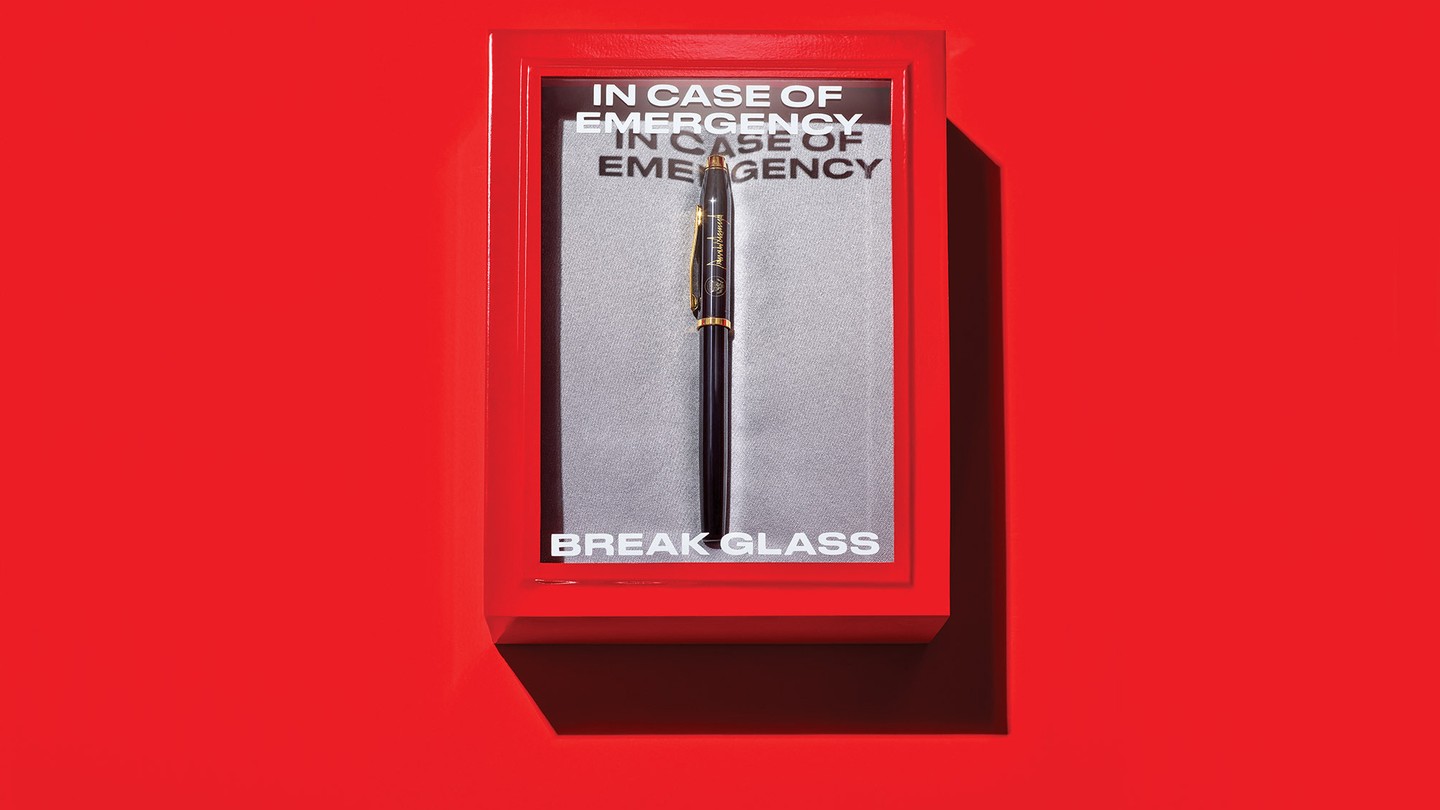
The Alarming Scope of the President's Emergency Powers
From seizing control of the internet to declaring martial law, President Trump may legally practise all kinds of extraordinary things.
Idue north the weeks leading upwards to the 2018 midterm elections, President Donald Trump reached deep into his arsenal to effort to deliver votes to Republicans.
Most of his weapons were rhetorical, featuring a mix of lies and faux inducements—claims that every congressional Democrat had signed on to an "open borders" bill (none had), that liberals were fomenting violent "mobs" (they weren't), that a x percent tax cut for the eye course would somehow pass while Congress was out of session (it didn't). But a few involved the ambitious employ—and threatened misuse—of presidential authority: He sent thousands of active-duty soldiers to the southern border to terrorize a afar caravan of drastic Key American migrants, announced plans to finish the ramble guarantee of birthright citizenship by executive order, and tweeted that law enforcement had been "strongly notified" to be on the lookout for "ILLEGAL VOTING."
These measures failed to comport the solar day, and Trump will likely conclude that they were besides timid. How much further might he become in 2020, when his own name is on the election—or sooner than that, if he'southward facing impeachment by a House nether Autonomous control?
More is at stake here than the event of one or even two elections. Trump has long signaled his disdain for the concepts of limited presidential ability and democratic dominion. During his 2016 campaign, he praised murderous dictators. He declared that his opponent, Hillary Clinton, would be in jail if he were president, goading crowds into frenzied chants of "Lock her up." He hinted that he might not have an electoral loss. As democracies around the world slide into autocracy, and nationalism and antidemocratic sentiment are on bright display amidst segments of the American populace, Trump's evident hostility to central elements of liberal democracy cannot be dismissed as mere bluster.
It would be squeamish to recollect that America is protected from the worst excesses of Trump's impulses by its democratic laws and institutions. After all, Trump tin do only so much without bumping up confronting the limits set by the Constitution and Congress and enforced by the courts. Those who see Trump equally a threat to commonwealth comfort themselves with the belief that these limits will hold him in bank check.
But volition they? Unknown to virtually Americans, a parallel legal regime allows the president to sidestep many of the constraints that usually apply. The moment the president declares a "national emergency"—a decision that is entirely within his discretion—more than 100 special provisions become available to him. While many of these tee up reasonable responses to genuine emergencies, some appear dangerously suited to a leader bent on amassing or retaining power. For instance, the president can, with the flick of his pen, activate laws allowing him to shut down many kinds of electronic communications inside the United States or freeze Americans' bank accounts. Other powers are available even without a declaration of emergency, including laws that allow the president to deploy troops inside the country to subdue domestic unrest.
This building of boggling powers has historically rested on the assumption that the president will act in the country's best interest when using them. With a scattering of noteworthy exceptions, this assumption has held upward. Merely what if a president, backed into a corner and facing balloter defeat or impeachment, were to declare an emergency for the sake of holding on to power? In that scenario, our laws and institutions might not salvage u.s. from a presidential ability grab. They might be what takes u.s.a. down.
1. "A LOADED WEAPON"
The premise underlying emergency powers is simple: The government's ordinary powers might be insufficient in a crisis, and amending the law to provide greater ones might exist too slow and cumbersome. Emergency powers are meant to requite the government a temporary boost until the emergency passes or in that location is time to change the law through normal legislative processes.
Different the modern constitutions of many other countries, which specify when and how a state of emergency may be declared and which rights may exist suspended, the U.S. Constitution itself includes no comprehensive separate regime for emergencies. Those few powers it does contain for dealing with certain urgent threats, information technology assigns to Congress, not the president. For instance, it lets Congress append the writ of habeas corpus—that is, allow government officials to imprison people without judicial review—"when in Cases of Rebellion or Invasion the public Safety may crave it" and "provide for calling forth the Militia to execute the Laws of the Union, suppress Insurrections and repel Invasions."
Yet, some legal scholars believe that the Constitution gives the president inherent emergency powers by making him commander in chief of the armed forces, or past vesting in him a wide, undefined "executive Power." At central points in American history, presidents have cited inherent constitutional powers when taking drastic deportment that were not authorized—or, in some cases, were explicitly prohibited—by Congress. Notorious examples include Franklin D. Roosevelt'southward internment of U.S. citizens and residents of Japanese descent during World War Two and George W. Bush'south programs of warrantless wiretapping and torture afterward the 9/eleven terrorist attacks. Abraham Lincoln conceded that his unilateral suspension of habeas corpus during the Civil War was constitutionally questionable, simply dedicated it as necessary to preserve the Union.
The Supreme Court has frequently upheld such actions or found ways to avoid reviewing them, at least while the crisis was in progress. Rulings such as Youngstown Sail & Tube Company 5. Sawyer, in which the Court invalidated President Harry Truman's bid to take over steel mills during the Korean War, accept been the exception. And while those exceptions take outlined important limiting principles, the outer boundary of the president's constitutional authority during emergencies remains poorly defined.
Presidents can also rely on a cornucopia of powers provided by Congress, which has historically been the principal source of emergency authorisation for the executive co-operative. Throughout the belatedly 18th and 19th centuries, Congress passed laws to give the president boosted leeway during military, economical, and labor crises. A more than formalized arroyo evolved in the early on 20th century, when Congress legislated powers that would lie dormant until the president activated them past declaring a national emergency. These statutory regime began to pile up—and because presidents had piddling incentive to terminate states of emergency once alleged, these piled upward too. By the 1970s, hundreds of statutory emergency powers, and four clearly obsolete states of emergency, were in effect. For example, the national emergency that Truman declared in 1950, during the Korean State of war, remained in place and was being used to help prosecute the war in Vietnam.
Aiming to rein in this proliferation, Congress passed the National Emergencies Act in 1976. Nether this law, the president still has complete discretion to issue an emergency declaration—but he must specify in the proclamation which powers he intends to use, issue public updates if he decides to invoke additional powers, and report to Congress on the government'due south emergency-related expenditures every six months. The country of emergency expires after a year unless the president renews it, and the Senate and the Firm must see every half-dozen months while the emergency is in result "to consider a vote" on termination.
By whatever objective measure, the law has failed. 30 states of emergency are in effect today—several times more than when the act was passed. Nigh have been renewed for years on cease. And during the 40 years the law has been in place, Congress has not met fifty-fifty in one case, let lonely every half dozen months, to vote on whether to cease them.
As a result, the president has access to emergency powers contained in 123 statutory provisions, every bit recently calculated by the Brennan Heart for Justice at NYU School of Law, where I work. These laws address a broad range of matters, from armed services composition to agricultural exports to public contracts. For the most role, the president is free to use any of them; the National Emergencies Act doesn't require that the powers invoked relate to the nature of the emergency. Even if the crisis at hand is, say, a nationwide ingather blight, the president may activate the law that allows the secretary of transportation to requisition whatever privately owned vessel at sea. Many other laws allow the executive co-operative to take extraordinary action under specified conditions, such as war and domestic upheaval, regardless of whether a national emergency has been declared.
This legal authorities for emergencies—ambiguous ramble limits combined with a rich well of statutory emergency powers—would seem to provide the ingredients for a dangerous inroad on American civil liberties. Notwithstanding so far, fifty-fifty though presidents accept oftentimes advanced dubious claims of constitutional authority, egregious abuses on the scale of the Japanese American internment or the postal service-nine/11 torture programme have been rare, and most of the statutory powers bachelor during a national emergency have never been used.
But what's to guarantee that this president, or a future 1, will show the reticence of his predecessors? To borrow from Justice Robert Jackson'south dissent in Korematsu v. United states of america, the 1944 Supreme Court decision that upheld the internment of Japanese Americans, each emergency ability "lies about like a loaded weapon, ready for the hand of any authority that tin bring forrad a plausible claim of an urgent demand."
2. AN INTERNET Impale SWITCH?
Like all emergency powers, the laws governing the acquit of war allow the president to appoint in conduct that would be illegal during ordinary times. This conduct includes familiar incidents of war, such as the killing or indefinite detention of enemy soldiers. But the president tin also take a host of other actions, both abroad and inside the United States.
These laws vary dramatically in content and scope. Several of them authorize the president to brand decisions about the size and composition of the military machine that are commonly left to Congress. Although such measures can offer needed flexibility at crucial moments, they are bailiwick to misuse. For instance, George W. Bush leveraged the state of emergency after nine/11 to call hundreds of thousands of reservists and members of the National Guard into active duty in Iraq, for a war that had nothing to do with the nine/11 attacks. Other powers are chilling under any circumstances: Have a moment to consider that during a declared war or national emergency, the president can unilaterally suspend the law that bars government testing of biological and chemic agents on unwitting human subjects.
One power poses a singular threat to democracy in the digital era. In 1942, Congress amended Section 706 of the Communications Act of 1934 to allow the president to shut down or take control of "whatever facility or station for wire communication" upon his annunciation "that there exists a state or threat of war involving the United States," resurrecting a similar power Congress had briefly provided Woodrow Wilson during Earth War I. At the fourth dimension, "wire advice" meant telephone calls or telegrams. Given the relatively small-scale role that electronic communications played in nigh Americans' lives, the government's exclamation of this ability during World War Two (no president has used it since) likely created inconvenience but not havoc.
We live in a different universe today. Although interpreting a 1942 law to cover the internet might seem far-fetched, some authorities officials recently endorsed this reading during debates nearly cybersecurity legislation. Under this interpretation, Section 706 could finer function as a "impale switch" in the U.S.—one that would be bachelor to the president the moment he proclaimed a mere threat of war. It could too give the president ability to assume control over U.S. internet traffic.
The potential bear upon of such a move can hardly be overstated. In August, in an early-forenoon tweet, Trump lamented that search engines were "RIGGED" to serve upward negative articles nearly him. Afterward that twenty-four hour period the administration said it was looking into regulating the big internet companies. "I recall that Google and Twitter and Facebook, they're really treading on very, very troubled territory. And they have to be careful," Trump warned. If the regime were to take control of U.Southward. net infrastructure, Trump could achieve direct what he threatened to do by regulation: ensure that internet searches always render pro-Trump content as the top results. The authorities also would have the ability to impede domestic admission to particular websites, including social-media platforms. It could monitor emails or prevent them from reaching their destination. It could exert control over calculator systems (such as states' voter databases) and physical devices (such every bit Amazon'south Repeat speakers) that are connected to the internet.
Video: Trump's Emergency Powers Are "Ripe for Abuse"
To exist certain, the fact that the internet in the United states is highly decentralized—a function of a relatively open marketplace for communications devices and services—would offering some protection. Achieving the level of government command over internet content that exists in places such as China, Russia, and Iran would likely be impossible in the U.S. Moreover, if Trump were to attempt any degree of internet takeover, an explosion of lawsuits would follow. Based on its First Subpoena rulings in recent decades, the Supreme Courtroom seems unlikely to permit heavy-handed government control over internet communication.
But self-approbation would be a mistake. Consummate control of net content would not be necessary for Trump's purposes; even with less comprehensive interventions, he could do a great deal to disrupt political discourse and hinder effective, organized political opposition. And the Supreme Courtroom's view of the First Subpoena is not immutable. For much of the country's history, the Courtroom was willing to tolerate pregnant encroachments on gratuitous spoken language during wartime. "The progress we accept made is fragile," Geoffrey R. Stone, a constitutional-law scholar at the University of Chicago, has written. "Information technology would non take much to upset the current understanding of the Showtime Amendment." Indeed, all information technology would take is v Supreme Court justices whose commitment to presidential power exceeds their commitment to individual liberties.
3. SANCTIONING AMERICANS
Due northext to war powers, economic powers might sound beneficial, only they are amongst the president's almost strong legal weapons. All but two of the emergency declarations in effect today were issued under the International Emergency Economic Powers Human action, or ieepa. Passed in 1977, the police allows the president to declare a national emergency "to deal with any unusual and boggling threat"—to national security, foreign policy, or the economic system—that "has its source in whole or substantial part outside the Usa." The president tin then lodge a range of economic actions to accost the threat, including freezing avails and blocking financial transactions in which any foreign nation or strange national has an interest.
In the late 1970s and '80s, presidents used the law primarily to impose sanctions against other nations, including Iran, Nicaragua, South Africa, Libya, and Panama. And then, in 1983, when Congress failed to renew a law authorizing the Commerce Department to control sure exports, President Ronald Reagan declared a national emergency in gild to assume that control under ieepa. Subsequent presidents followed his example, transferring export control from Congress to the White House. President Bill Clinton expanded ieepa's usage past targeting not only foreign governments only strange political parties, terrorist organizations, and suspected narcotics traffickers.
President George Due west. Bush took matters a behemothic pace farther after ix/11. His Executive Guild 13224 prohibited transactions non just with whatsoever suspected strange terrorists, but with any greenhorn or any U.S. citizen suspected of providing them with support. One time a person is "designated" under the order, no American tin can legally give him a job, hire him an apartment, provide him with medical services, or even sell him a loaf of bread unless the government grants a license to permit the transaction. The patriot Human action gave the order more than muscle, assuasive the authorities to trigger these consequences just by opening an investigation into whether a person or grouping should be designated.
Designations under Executive Guild 13224 are opaque and extremely hard to challenge. The government needs only a "reasonable ground" for believing that someone is involved with or supports terrorism in gild to designate him. The target is by and large given no advance detect and no hearing. He may request reconsideration and submit show on his behalf, simply the government faces no deadline to answer. Moreover, the testify confronting the target is typically classified, which ways he is not allowed to see it. He tin try to challenge the activeness in court, simply his chances of success are minimal, as most judges defer to the regime's assessment of its own evidence.
Americans have occasionally been defenseless up in this Kafkaesque arrangement. Several Muslim charities in the U.Due south. were designated or investigated based on the suspicion that their charitable contributions overseas benefited terrorists. Of course if the authorities can testify, through judicial proceedings that observe due procedure and other ramble rights, that an American group or person is funding terrorist activeness, it should be able to cutting off those funds. But the government close these charities downwards past freezing their avails without ever having to prove its charges in court.
In other cases, Americans were significantly harmed by designations that afterward proved to be mistakes. For instance, two months after 9/eleven, the Treasury Department designated Garad Jama, a Somalian-born American, based on an erroneous conclusion that his money-wiring business was part of a terror-financing network. Jama'due south part was shut down and his depository financial institution business relationship frozen. News outlets described him as a suspected terrorist. For months, Jama tried to gain a hearing with the regime to establish his innocence and, in the meantime, obtain the government's permission to get a job and pay his lawyer. Merely subsequently he filed a lawsuit did the authorities allow him to work equally a grocery-store cashier and pay his living expenses. It was several more months before the government reversed his designation and unfroze his assets. Past then he had lost his business, and the stigma of having been publicly labeled a terrorist supporter continued to follow him and his family.
Despite these dramatic examples, ieepa's limits take yet to be fully tested. After two courts ruled that the government'due south deportment confronting American charities were unconstitutional, Barack Obama's administration chose non to appeal the decisions and largely refrained from further controversial designations of American organizations and citizens. Thus far, President Trump has followed the same approach.
That could change. In October, in the lead-upwardly to the midterm elections, Trump characterized the caravan of Primal American migrants headed toward the U.S. border to seek asylum as a "National Emergency." Although he did not upshot an emergency proclamation, he could exercise so under ieepa. He could determine that whatsoever American within the U.S. who offers material support to the asylum seekers—or, for that matter, to undocumented immigrants within the U.s.—poses "an unusual and extraordinary threat" to national security, and authorize the Treasury Department to take action against them.
Such a move would carry echoes of a law passed recently in Republic of hungary that criminalized the provision of financial or legal services to undocumented migrants; this has been dubbed the "Cease Soros" law, after the Hungarian American philanthropist George Soros, who funds migrants'-rights organizations. Although an social club issued under ieepa would not land targets in jail, information technology could be implemented without legislation and without affording targets a trial. In practice, identifying every American who has hired, housed, or provided paid legal representation to an asylum seeker or undocumented immigrant would be incommunicable—but all Trump would need to practise to achieve the desired political result would be to make high-profile examples of a few. Individuals targeted past the order could lose their jobs, and detect their bank accounts frozen and their health insurance canceled. The battle in the courts would and then option upwardly exactly where it left off during the Obama administration—merely with a newly reconstituted Supreme Courtroom making the final phone call.
four. BOOTS ON MAIN STREET
The idea of tanks rolling through the streets of U.S. cities seems fundamentally inconsistent with the country's notions of democracy and freedom. Americans might be surprised, therefore, to learn just how readily the president can deploy troops inside the country.
The principle that the armed forces should not act equally a domestic police force, known as "posse comitatus," has deep roots in the nation's history, and it is oftentimes mistaken for a ramble rule. The Constitution, however, does not prohibit war machine participation in police activity. Nor does the Posse Comitatus Human action of 1878 outlaw such participation; it merely states that any authority to utilise the war machine for constabulary-enforcement purposes must derive from the Constitution or from a statute.
The Insurrection Act of 1807 provides the necessary authority. As amended over the years, it allows the president to deploy troops upon the request of a state'southward governor or legislature to assistance put downwardly an insurrection within that state. It also allows the president to deploy troops unilaterally, either because he determines that rebellious action has fabricated it "impracticable" to enforce federal police through regular means, or considering he deems it necessary to suppress "insurrection, domestic violence, unlawful combination, or conspiracy" (terms not defined in the statute) that hinders the rights of a class of people or "impedes the course of justice."
Presidents have wielded the Insurrection Human action under a range of circumstances. Dwight Eisenhower used information technology in 1957 when he sent troops into Fiddling Rock, Arkansas, to enforce school desegregation. George H. W. Bush employed information technology in 1992 to assist stop the riots that erupted in Los Angeles afterwards the verdict in the Rodney Male monarch case. George Due west. Bush-league considered invoking it to help restore public order after Hurricane Katrina, simply opted confronting it when the governor of Louisiana resisted federal control over the state's National Guard. While controversy surrounded all these examples, none suggests obvious overreach.
And even so the potential misuses of the act are legion. When Chicago experienced a spike in homicides in 2017, Trump tweeted that the city must "prepare the horrible 'carnage' " or he would "send in the Feds!" To carry out this threat, the president could declare a detail street gang—say, MS‑13—to be an "unlawful combination" and so send troops to the nation'south cities to police the streets. He could characterize sanctuary cities—cities that refuse to provide assist to clearing-enforcement officials—as "conspiracies" against federal government, and gild the military to enforce immigration laws in those places. Conjuring the specter of "liberal mobs," he could send troops to suppress declared rioting at the fringes of anti-Trump protests.
How far could the president go in using the military inside U.Due south. borders? The Supreme Court has given the states no articulate respond to this question. Accept Ex parte Milligan, a famous ruling from 1866 invalidating the use of a military commission to endeavour a civilian during the Civil War. The case is widely considered a high-water mark for judicial constraint on executive action. Nevertheless even every bit the Courtroom held that the president could not use state of war or emergency every bit a reason to featherbed noncombatant courts, it noted that martial law—the deportation of civilian authorisation by the armed services—would be appropriate in some cases. If civilian courts were airtight as a result of a foreign invasion or a civil war, for example, martial law could exist "until the laws tin can have their costless class." The message is decidedly mixed: Claims of emergency or necessity cannot legitimize martial law … until they can.
Presented with this ambiguity, presidents have explored the outer limits of their constitutional emergency authority in a series of directives known every bit Presidential Emergency Action Documents, or peaddue south. peadsouthward, which originated as part of the Eisenhower administration's plans to ensure continuity of regime in the wake of a Soviet nuclear assault, are typhoon executive orders, proclamations, and messages to Congress that are prepared in advance of anticipated emergencies. peads are closely guarded within the authorities; none has always been publicly released or leaked. But their contents accept occasionally been described in public sources, including FBI memorandums that were obtained through the Freedom of Data Human activity as well as agency manuals and court records. According to these sources, peads drafted from the 1950s through the 1970s would authorize non only martial law but the intermission of habeas corpus past the executive branch, the revocation of Americans' passports, and the roundup and detention of "subversives" identified in an FBI "Security Index" that contained more than x,000 names.
Less is known about the contents of more than recent peadsouth and equivalent planning documents. But in 1987, The Miami Herald reported that Lieutenant Colonel Oliver North had worked with the Federal Emergency Direction Bureau to create a surreptitious contingency plan authorizing "suspension of the Constitution, turning control of the Usa over to fema, appointment of military commanders to run state and local governments and announcement of martial law during a national crisis." A 2007 Department of Homeland Security study lists "martial law" and "curfew declarations" equally "critical tasks" that local, state, and federal government should be able to perform in emergencies. In 2008, government sources told a reporter for Radar mag that a version of the Security Index nevertheless existed under the lawmaking proper name Primary Core, assuasive for the anticipation and detention of Americans tagged as security threats.
Since 2012, the Section of Justice has been requesting and receiving funds from Congress to update several dozen peadsouthward get-go developed in 1989. The funding requests contain no indication of what these peads comprehend, or what standards the department intends to apply in reviewing them. But whatsoever the Obama administration's intent, the review has now passed to the Trump administration. It will fall to Jeff Sessions's successor as attorney general to make up one's mind whether to rein in or expand some of the more frightening features of these peads. And, of class, information technology will exist upwards to President Trump whether to actually use them—something no previous president appears to accept done.
five. KINDLING AN EMERGENCY
Wchapeau would the Founders think of these and other emergency powers on the books today, in the hands of a president similar Donald Trump? In Youngstown, the case in which the Supreme Courtroom blocked President Truman's attempt to seize the nation's steel mills, Justice Jackson observed that wide emergency powers were "something the forefathers omitted" from the Constitution. "They knew what emergencies were, knew the pressures they engender for authoritative action, knew, too, how they beget a ready pretext for usurpation," he wrote. "Nosotros may also suspect that they suspected that emergency powers would tend to kindle emergencies."
In the past several decades, Congress has provided what the Constitution did not: emergency powers that accept the potential for creating emergencies rather than ending them. Presidents have congenital on these powers with their own secret directives. What has prevented the wholesale abuse of these authorities until now is a baseline commitment to liberal democracy on the function of by presidents. Under a president who doesn't share that delivery, what might nosotros see?
Imagine that it'southward late 2019. Trump's blessing ratings are at an all-fourth dimension depression. A disgruntled former employee has leaked documents showing that the Trump Organization was involved in illegal business organisation dealings with Russian oligarchs. The trade war with Prc and other countries has taken a meaning toll on the economy. Trump has been defenseless once again disclosing classified information to Russian officials, and his international gaffes are becoming impossible for lawmakers concerned about national security to ignore. A few of his Republican supporters in Congress begin to distance themselves from his administration. Support for impeachment spreads on Capitol Hill. In harbinger polls pitting Trump against diverse potential Democratic presidential candidates, the Democrat consistently wins.
Trump reacts. Unfazed by his own brazen hypocrisy, he tweets that Iran is planning a cyber operation to interfere with the 2020 ballot. His national-security adviser, John Bolton, claims to take seen ironclad (but highly classified) prove of this planned assault on U.S. commonwealth. Trump's inflammatory tweets provoke predictable saber rattling by Iranian leaders; he responds by threatening preemptive war machine strikes. Some Defence Department officials have misgivings, just others have been waiting for such an opportunity. As Islamic republic of iran's statements grow more warlike, "Iranophobia" takes hold among the American public.
Proclaiming a threat of war, Trump invokes Department 706 of the Communications Human action to presume authorities control over internet traffic within the United states, in lodge to forbid the spread of Iranian disinformation and propaganda. He likewise declares a national emergency nether ieepa, authorizing the Treasury Department to freeze the assets of any person or arrangement suspected of supporting Iran's activities against the United states. Wielding the authorization conferred by these laws, the government shuts downwardly several left-leaning websites and domestic civil-lodge organizations, based on regime determinations (classified, of course) that they are bailiwick to Iranian influence. These include websites and organizations that are focused on getting out the vote.
Lawsuits follow. Several judges consequence orders declaring Trump'southward actions unconstitutional, but a handful of judges appointed by the president side with the assistants. On the eve of the election, the cases accomplish the Supreme Courtroom. In a 5–4 opinion written by Justice Brett Kavanaugh, the Court observes that the president's powers are at their zenith when he is using say-so granted by Congress to protect national security. Setting new precedent, the Court holds that the Offset Subpoena does non protect Iranian propaganda and that the government needs no warrant to freeze Americans' avails if its goal is to mitigate a strange threat.
Protests erupt. On Twitter, Trump calls the protesters traitors and suggests (in capital letters) that they could use a good beating. When counterprotesters oblige, Trump blames the original protesters for sparking the fierce confrontations and deploys the Coup Human action to federalize the National Baby-sit in several states. Using the Presidential Alarm organization kickoff tested in October 2018, the president sends a text message to every American's cellphone, warning that in that location is "a risk of violence at polling stations" and that "troops will be deployed every bit necessary" to keep social club. Some members of opposition groups are frightened into staying home on Election Twenty-four hours; other people simply can't find accurate information online about voting. With turnout at a historical low, a president who was facing impeachment but months earlier handily wins reelection—and marks his victory past renewing the state of emergency.
This scenario might sound extreme. But the misuse of emergency powers is a standard gambit amongst leaders attempting to consolidate ability. Authoritarians Trump has openly claimed to admire—including the Philippines' Rodrigo Duterte and Turkey's Recep Tayyip Erdoğan—have gone this route.
Of course, Trump might also choose to human activity entirely exterior the constabulary. Presidents with a far stronger delivery to the rule of law, including Lincoln and Roosevelt, have washed exactly that, albeit in response to real emergencies. Only there is little that can be done in accelerate to end this, other than attempting deterrence through robust oversight. The remedies for such behavior can come up only after the fact, via court judgments, political blowback at the voting booth, or impeachment.
Past contrast, the dangers posed past emergency powers that are written into statute can be mitigated through the elementary expedient of changing the law. Committees in the House could begin this process now by undertaking a thorough review of existing emergency powers and declarations. Based on that review, Congress could repeal the laws that are obsolete or unnecessary. Information technology could revise others to include stronger protections against abuse. Information technology could result new criteria for emergency declarations, require a connection between the nature of the emergency and the powers invoked, and prohibit indefinite emergencies. It could limit the powers gear up forth in peadsouth.
Congress, of class, will undertake none of these reforms without extraordinary public pressure level—and until now, the public has paid little heed to emergency powers. Simply we are in uncharted political territory. At a time when other democracies around the world are slipping toward authoritarianism—and when the president seems eager for the United States to follow their case—we would be wise to shore up the guardrails of liberal democracy. Fixing the current system of emergency powers would be a good place to start.
This article appears in the January/February 2019 print edition with the headline "In Case of Emergency."
Source: https://www.theatlantic.com/magazine/archive/2019/01/presidential-emergency-powers/576418/
0 Response to "Does the President Read or Respond to Letters"
Postar um comentário